
Share this product :
Ferric Chloride Anhydrous
- Origin
- : China
- CAS Number
- : 7705-08-0
- HS Code
- : 38220090
Basic Info
- IUPAC Name
- : iron(III) chloride
- Molecular Formula
- : FeCl3
- Molecular Weight (g/mol)
- : 162.2000
- Synonyms & Trade Names
- : Ferric chloride anhydrous; Iron(III) trichloride; FeCl3
- Purity / Assay (%)
- : 98% min
- Grade / Quality Level
- : Technical Grade
- Physical Form
- : Solid
- Concentration
- : Pure substance
- Appearance / Color
- : White to off-white solid
- Odor
- : Slight HCl-like
- Melting Point (°C)
- : 307.0000
- Boiling Point (°C)
- : 316 (sublimes)
- Density (g/cm³)
- : 2.8980
- Solubility in Water
- : Freely soluble
- Signal Word
- : Danger
- UN Number
- : 1773
- GHS Hazard Class
- : Skin corrosive; Eye corrosive; Aquatic hazard
- H-Statements
- : H290|H302|H312|H314|H332|H400|H410
- P-Statements
- : P234|P260|P264|P270|P273|P280|P301+P330+P331
- REACH Status
- : Registered
- Drug Precursor Status
- : Non-precursor
- Storage Class (GHS)
- : 8
- Storage Conditions
- : Dry; away from moisture; corrosive
Categories
Share this product :
Brief Overview
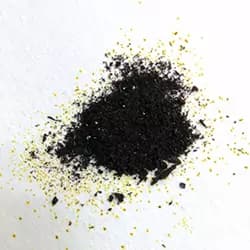
Ferric Chloride (Iron(III) Chloride) is a brown to black coloured inorganic compound with the chemical formula FeCl3. Ferric Chloride occurs naturally in the form of a mineral named molysite. It forms an exothermic reaction when undergoing hydrolysis, thus forming a very corrosive brown coloured acidic solution which is used in widespread applications such as sewage treatment, water purification, etching printed circuit boards, and as a catalyst in organic synthesis reactions. It has a low melting point but a relatively high boiling point of 319∘C.
Manufacturing Process
Ferric Chloride is commercially manufactured in an ebonized reactor. Hydrochloric acid and ferric oxide are combined in the reactor, stirred, and heated. The reaction is exothermic and will generate heat. This reaction is carried out at a constant temperature of between 80 to 90∘C and at atmospheric pressure for about five hours. As the reaction reaches completion, the mixture is allowed to remain in the reactor for an additional 10 to 12 hours such that sedimentation of the excess ferric oxide occurs. The resulting ferric oxide is separated, washed, dried, and sent for size reduction operations to obtain the size required as per customers’ demands.