
Share this product :
Sodium Sulfide (Yellow)
- Origin
- : China, Sri Lanka
- CAS Number
- : 1313-82-2
- HS Code
- : 2815.11.00
Basic Info
- IUPAC Name
- : disodium sulfide
- Molecular Formula
- : Na2S
- Molecular Weight (g/mol)
- : 78.0400
- Synonyms & Trade Names
- : Sodium sulfide; Sodium sulphide; Disodium monosulfide
- Purity / Assay (%)
- : 60% min
- Grade / Quality Level
- : Industrial Grade
- Physical Form
- : Solid
- Concentration
- : Pure substance
- Appearance / Color
- : White to off-white solid
- Odor
- : Hydrogen sulfide-like
- Melting Point (°C)
- : 1180.0000
- Density (g/cm³)
- : 1.8560
- Solubility in Water
- : Freely soluble
- Signal Word
- : Danger
- UN Number
- : 1385
- GHS Hazard Class
- : Acute toxic; Skin corrosive; Aquatic hazard
- H-Statements
- : H290|H301|H311|H314|H331|H400|H410
- P-Statements
- : P234|P260|P264|P273|P280|P301+P330+P331
- REACH Status
- : Registered
- Drug Precursor Status
- : Non-precursor
- Storage Class (GHS)
- : 4.2
- Storage Conditions
- : Cool, dry; away from moisture and acids
Categories
Share this product :
Overview of Sodium Sulfide (Na2S)
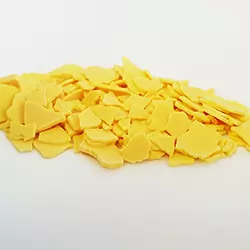
Sodium sulfide anhydrous has a formula of Na2S and exists mainly in the nonahydrated form, Na2S*9H2O. Anhydrous sodium sulfide is a white crystalline solid whereas sodium sulfide flasks are yellow in appearance. This is due to the presence of polysulfide in sodium sulfide flakes, giving its yellow appearance. However, both the anhydrous and hydrated forms are soluble in water and give a colorless alkaline solution readily.
Sodium sulfide adopts an anti-fluoride structure, where the smaller sodium ions occupy the larger sulfide ions holes in a crystal lattice and vice versa. It can also be oxidized when heated to yield sodium carbonate and sulfur dioxide. When exposed to air, sodium sulfide smells like rotten egg and this is due to the releases of hydrogen sulfide gas. In addition, sodium sulfide can be treated with sulfur to yield polysulfide.
Manufacturing Process
1. Laboratory Scale
Using small-scale laboratory method, sodium sulfide is manufactured by reducing sulfur with sodium in anhydrous ammonia. Sulfur can also be reduced by sodium in tetrahydrofuran solvent with minute amounts of naphthalene catalyst. Alternatively, sodium sulfide can also be manufactured from the reaction within each set of reactants such as (a) caustic soda and sulfur, (b) barium sulfate and soda ash and (c) sodium sulfite and coal.
2. Industrial Scale
Being the oldest method of production, sodium sulfide is manufactured by reducing sodium sulfate with powdered coal in a reverberator furnace. However, this method requires harsh reaction conditions such as high temperature of 900 and a specially designed furnace to withstand such temperature. A more efficient alternative would be to use barium sulfate, a different metal salt as the starting compound. Reducing barium sulfate does not require drastic reaction.